

Hey there, fellow cake lovers and Christmas enthusiasts! I'm an acrylic Christmas cake topper supplier, and I've been getting a bunch of questions lately about whether these cute little toppers change shape in high temperatures. So, I thought I'd dive into this topic and share what I know.
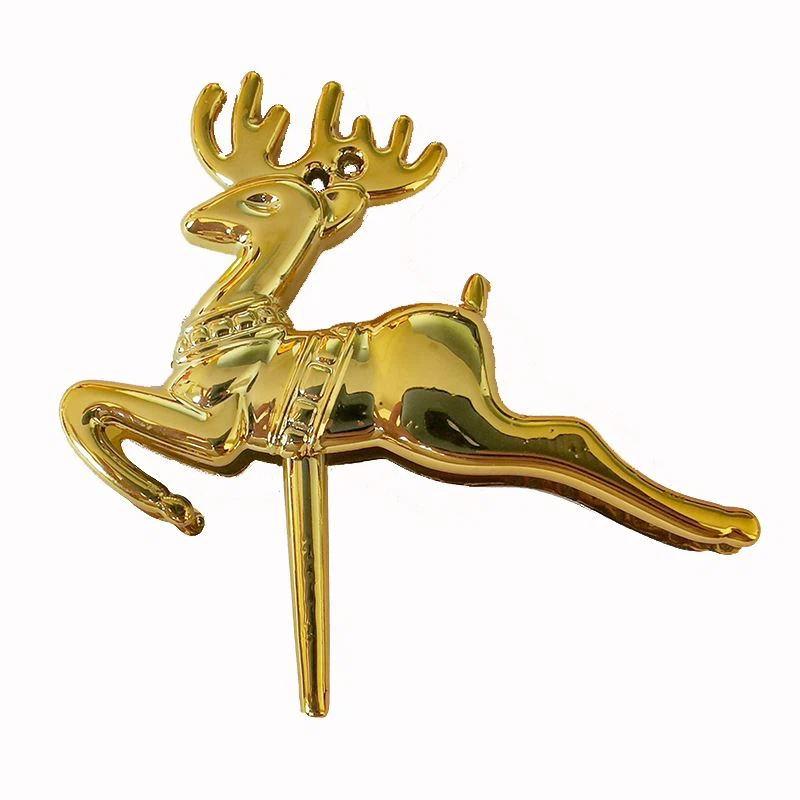
First off, let's talk about what acrylic is. Acrylic, also known as polymethyl methacrylate (PMMA), is a type of plastic. It's popular for cake toppers because it's clear, lightweight, and can be molded into all sorts of fun shapes. Think of those Christmas Gift Cake Decoration that look so realistic or the Christmas Deer Cake Decoration that add a touch of whimsy to any cake.
Now, the big question: does acrylic change shape in high temperatures? The short answer is yes, it can. Acrylic has a glass transition temperature (Tg), which is the temperature at which it starts to soften and become more flexible. For most acrylics, this Tg is around 100 - 110°C (212 - 230°F).

But let's be real, your cake is not going to be sitting in an environment that hot. However, there are still some situations where high temperatures can be a concern. For example, if you're shipping the cake toppers during a really hot summer day, or if they're stored in a place that gets very warm, like a non - air - conditioned storage shed.
When acrylic is exposed to temperatures close to its Tg, it might start to deform. You could notice that the edges of your Christmas Wreath Cake Decoration start to get a bit wavy, or the details on a topper might become less sharp. It's not like it's going to melt into a puddle, but the shape will definitely change.
So, what can we do to prevent this from happening? As a supplier, I take a few precautions. When I'm shipping the cake toppers, I make sure to use insulated packaging. This helps to keep the temperature inside the box stable, even if it's hot outside. I also try to ship during cooler parts of the day or choose shipping services that have climate - controlled facilities.
If you're a customer, you can also do your part. Once you receive the toppers, store them in a cool, dry place. Avoid leaving them in direct sunlight for long periods, as the heat from the sun can also cause the acrylic to heat up. And if you're using the toppers on a cake that's going to be outdoors for a long time during a hot day, try to keep the cake in the shade or use a cooling device, like a small ice pack wrapped in a cloth, to keep the area around the cake cool.
Another thing to consider is the thickness of the acrylic. Thicker acrylic toppers are generally more resistant to temperature changes. They take longer to heat up and are less likely to deform. When I'm making the toppers, I try to find a good balance between thickness and weight. I want the toppers to be sturdy enough to withstand normal handling and temperature variations, but not so heavy that they sink into the cake.
I also want to mention that different manufacturing processes can affect how the acrylic responds to heat. Injection - molded acrylic toppers, for example, might have a more uniform structure and could be more resistant to temperature changes compared to toppers that are cut from a sheet of acrylic.
In conclusion, while acrylic Christmas cake toppers can change shape in high temperatures, with the right precautions, we can minimize the risk. As a supplier, I'm always looking for ways to improve the quality of my products and ensure that they reach you in perfect condition. Whether it's a Christmas Gift Cake Decoration for a loved one or a Christmas Deer Cake Decoration for a party, I want you to be able to enjoy these beautiful toppers without any worries.
If you're interested in purchasing our acrylic Christmas cake toppers, I'd love to have a chat with you. We can discuss your specific needs, whether it's a custom design or a bulk order. Just reach out, and we can start the conversation about making your Christmas cakes even more special.
References
- "Properties of Acrylic Plastics", Polymer Science Handbook
- "Temperature Effects on Plastic Materials", Industrial Plastics Journal